Cart
0
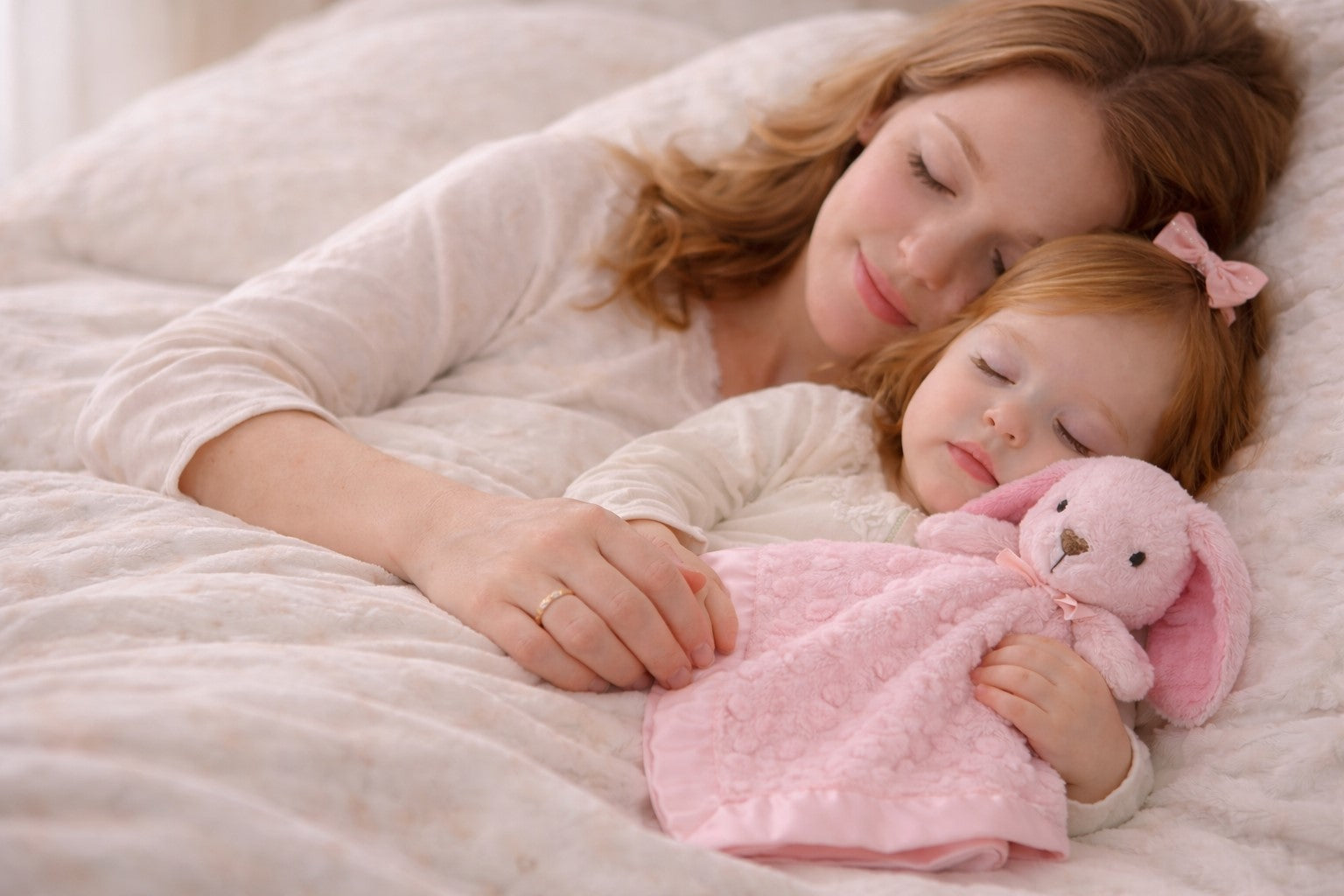
There is a reason her breathing softens when she holds something familiar.
It is not sentimentality.
It is neurobiology.
During early childhood, consistent tactile comfort objects function as attachment anchors. They lower physiological arousal, reduce nighttime cortisol variability, and support the transition from wakefulness to sleep stability. When a child curls around something known and soft, the nervous system recognizes safety.
Sleep is not a shutdown.
It is a regulated descent.
The architecture of healthy sleep in toddlers depends on three structural conditions:
1. Emotional security
2. Predictable ritual
3. Sensory familiarity

Remove any one of them and latency increases. Fragmentation increases. Stress markers increase.
When present together, sleep deepens.
Research in pediatric sleep medicine has demonstrated that bedtime transitional objects are associated with improved self-soothing and reduced night awakenings in early childhood. The mechanism is not mystical. It is regulatory. The object becomes a stable cue that bridges separation, signaling continuity of safety across sleep cycles.
In other words:
Comfort becomes infrastructure.
That small hand holding something soft is not indulgence.
It is architecture.
It is co-regulation becoming self-regulation.
And over time, that quiet repetition builds something larger than rest.
It builds resilience.
Academic Reference:
Mindell, J. A., Kuhn, B., Lewin, D. S., Meltzer, L. J., & Sadeh, A. (2006). Behavioral treatment of bedtime problems and night wakings in infants and young children. Sleep, 29(10), 1263–1276.
From one bedtime architect to another. ❤